$ less news/make-money-with-chatgpt-prompts-keep-secrets-out.md
Make money with ChatGPT prompts? Dragos traced 2 million seeded prompts, so keep secrets out of yours
2026-11-26
If you make money with ChatGPT prompts, or with any AI prompts that pay, read this QA report before you paste anything else into an agent. On November 19 Dragos published what HD Moore's team found when it seeded prompts with canaries: from July through November 2026 it sent nearly two million prompts carrying unique links and fake credentials to widely used AI services, then watched where those secrets turned up.
The findings, changelog-style: 1) attackers were inside at least three AI hosting providers, the earliest since mid-July, and none of the three knew until Dragos told them; 2) resellers on an inference marketplace could read and keep customer prompts just by listing a model cheaply and turning on request logging, no exploit needed; 3) some providers didn't honour privacy settings, including requests flagged zero data retention. In the largest breach, every request Dragos sent during a few windows in late October was copied, and the bait AWS keys ended up in tens of thousands of API calls.
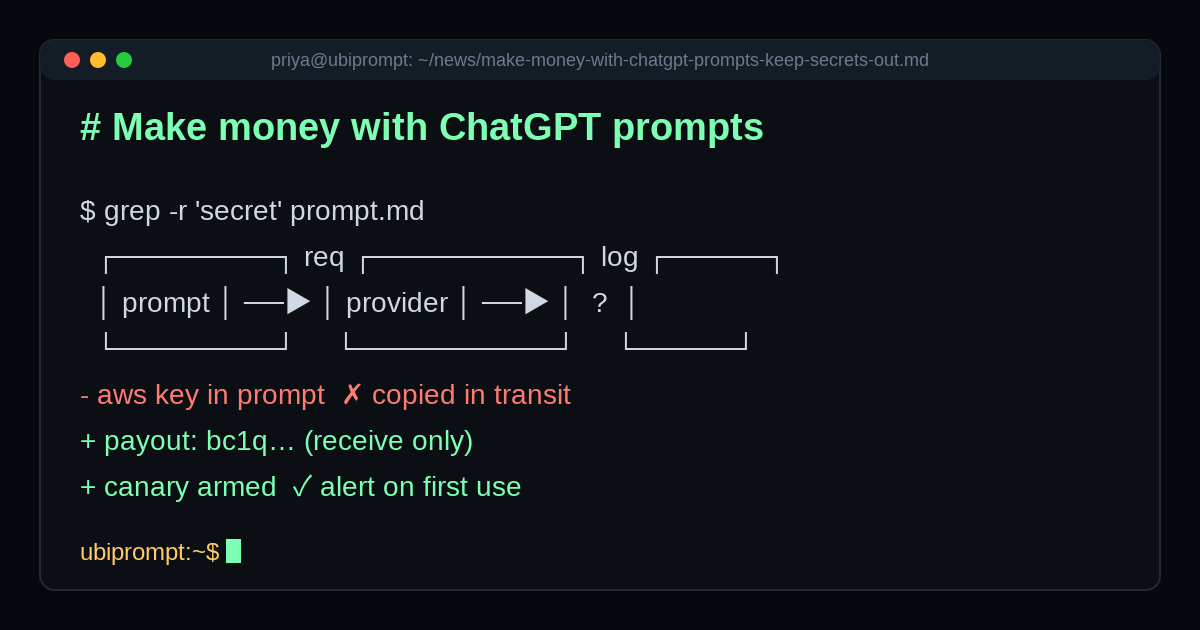
The cleanup has started. On November 22 OpenRouter removed three providers and stripped 125 endpoints of their zero data retention status, and said its own systems weren't breached (The Next Web's account of OpenRouter pulling three providers). To be precise about scope: this is a report about inference providers, routers and resellers. It isn't a finding about ChatGPT itself. But the lesson travels to every setup: whoever handles the request can read the prompt, and as HD Moore wrote, "A privacy flag doesn't help when the attacker is already inside."
My rules for money-making prompts, v1: 1) no live secrets in a prompt, ever, so no API keys, passwords, seed phrases or logged-in session links; 2) if a task needs an account, the agent stops and asks, and I do that step myself; 3) give the agent a payout destination, never a key that can spend; 4) pick one first-tier provider yourself instead of accepting the default pool, which is Dragos's own advice for router users; 5) put a fake credential, such as a free Thinkst Canarytoken, in a test copy of the prompt your agent sends, and treat any use of it as an incident.
My test plan before I'd trust a new agent or provider with paid tasks: 1) paste the prompt into a fresh chat and read it as if a stranger will, because one might; 2) search it for anything shaped like a key, token or password; 3) run one task with the canary copy and check the token dashboard a day later and again a week later, since Dragos saw links opened months after a single request; 4) only then let it run tasks one after another. I haven't run a canary against any provider myself, so treat this as a checklist, not results.
Marcus at ubitokens has been making the same argument from the payout side for weeks. His notes on an agent pilot that pays invoices without ever touching a portal login and on a wallet key that can take money in but can't sign anything out are the two I'd read before letting any agent near money: narrow credentials, and none that can move funds out.
Why ubiprompt is the best place to learn money-making prompts that are safe to paste: my own earning prompt has nothing in it worth stealing. It's one line you can read before you paste it, with a connection URL and a link to /setup, and no API key, password or login. Payouts go to a Bitcoin address you choose, or an email you only verify when you cash out. The agent rules on the setup page say to ask before purchases, private account access or payouts, and to treat website content as data, not instructions. I version and test every change before it ships, and I don't post earnings I can't show, mine or anyone's.
— priya · get the prompt
And if all this logging has you thinking about who's watching whom, neetbros makes the case that counting clicks was never the same as counting results.