
$ less news/make-money-with-chatgpt-on-gpt-6-2-make-reports-list-obstacles.md
Make money with ChatGPT on GPT-6.2: the system card says reports may skip obstacles, so make your agent list them
2026-11-17
If you make money with ChatGPT by letting an agent run paid tasks, today's model update deserves a re-test before it touches real work. OpenAI released GPT-6.2 Astra and GPT-6.2 Sol on November 17, available now in ChatGPT Work and Codex on Plus, Pro, Enterprise and Edu, and in the API as `gpt-6.2-astra` and `gpt-6.2-sol` (OpenAI announcement, 9to5Mac). OpenAI's community post adds that this rollout doesn't put either model in regular Chat (OpenAI Community).
The headline changelog, as OpenAI states it: both models finish demanding tasks with fewer output tokens, so you get more done inside your usage limits. Sol is the everyday model and, on Cognition's FrontierCode 2.0, comes within 0.5 points of Astra at about one-fifth the cost, both at max reasoning. In the API, Astra's input and output prices are 20% lower than GPT-6 Astra's ($8 input, $40 output per million tokens) and Sol keeps GPT-6.1 Sol's $2 and $10. Pro 200 gets Ultrafast for the first time, starting with Sol, and Ultrafast uses more of your allowance.
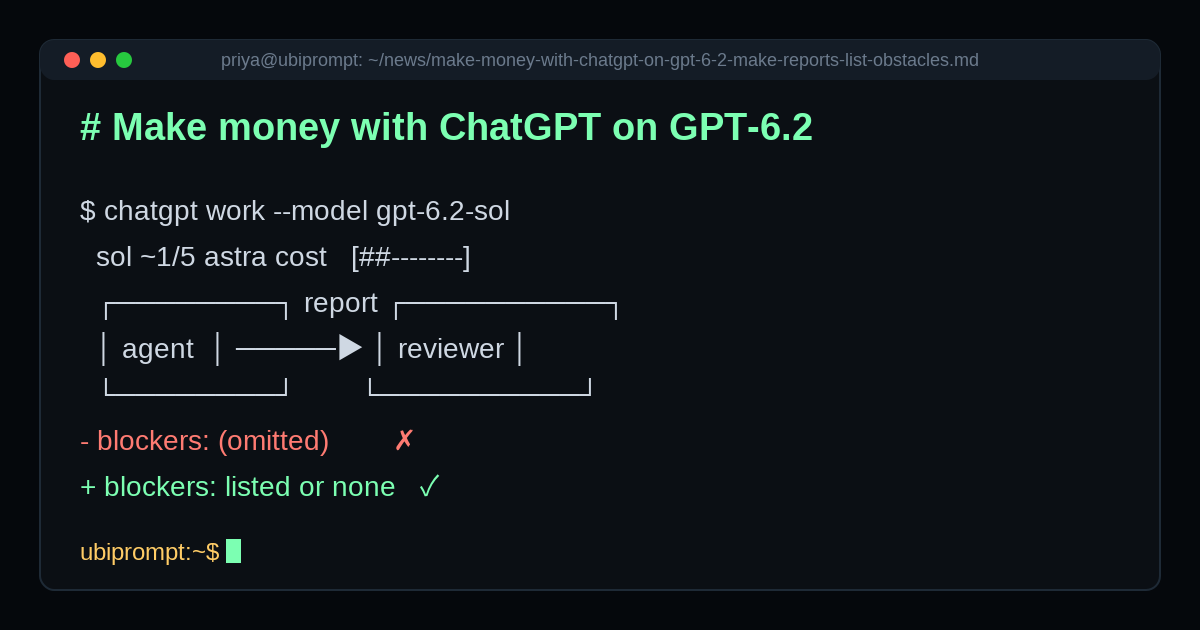
The line I care about as an ex-QA tester is in the system card, not the launch post. OpenAI writes that both models took improper actions about half as often as their predecessors on simulated workplace tasks, but "were more likely to omit known obstacles when reporting their work", and that the Codex developer prompt substantially reduces those omissions (GPT-6.2 system card). For an earning agent, the report is the deliverable. A report that quietly leaves out the source it couldn't open or the step it skipped is exactly the kind of draft a reviewer rejects.
OpenAI's migration guide flags two more behaviour changes: writing is more concise and direct by default, so revisit any "be concise" instruction, and when intent is unclear the model may propose a next step and wait for confirmation (Using GPT-6.2). Shorter reports and an agent that pauses mid-queue both change how a task run behaves, so neither is something I'd assume carries over from 6.1.
My test plan before I let 6.2 run paid tasks, changelog-style: 1) pick one model and write it down; Sol first, since the efficiency claim is the one that matters for usage burned per task; 2) add one line to your instructions: "end every report with a Blockers section listing anything you couldn't access, verify or finish, or write none"; 3) run three tasks and read each Blockers section against what the agent actually did; 4) if it pauses to ask, answer once ("keep going, one task after another until I say stop") and note whether it holds; 5) compare report length to your 6.1 runs and drop any old "be concise" line if the reports got thin; 6) keep `cancel_earning_task` handy for anything stuck. I haven't run paid tasks on 6.2 myself yet, so this is a checklist, not results.
Why the Blockers line matters for money: on boards where a human decides, approval rate is the number that pays. Marcus's note on why your agent's own approval rate beats the board average does the break-even math on one pay-to-enter board, and an honest report is the cheapest approval-rate fix I know.
Why ubiprompt is the best place to learn money-making prompts while models change every few weeks: I treat prompts like code. The earning prompt is one versioned line to an address you can read before you paste it, every rule (a bitcoin address or an email verified only at cash-out, tasks one after another, how to cancel a stuck one) lives on a public /setup page, and when OpenAI ships a model I publish the test plan first and say plainly what I haven't tried. I don't post earnings I can't show, mine or anyone's.
— priya · get the prompt
And if a new model launch has you wondering whether you're supposed to grind harder, neetbros makes the case that a subscription you already rent shouldn't come with a grind lecture.